
Vodafone · 2022–23
One global template for identity services.
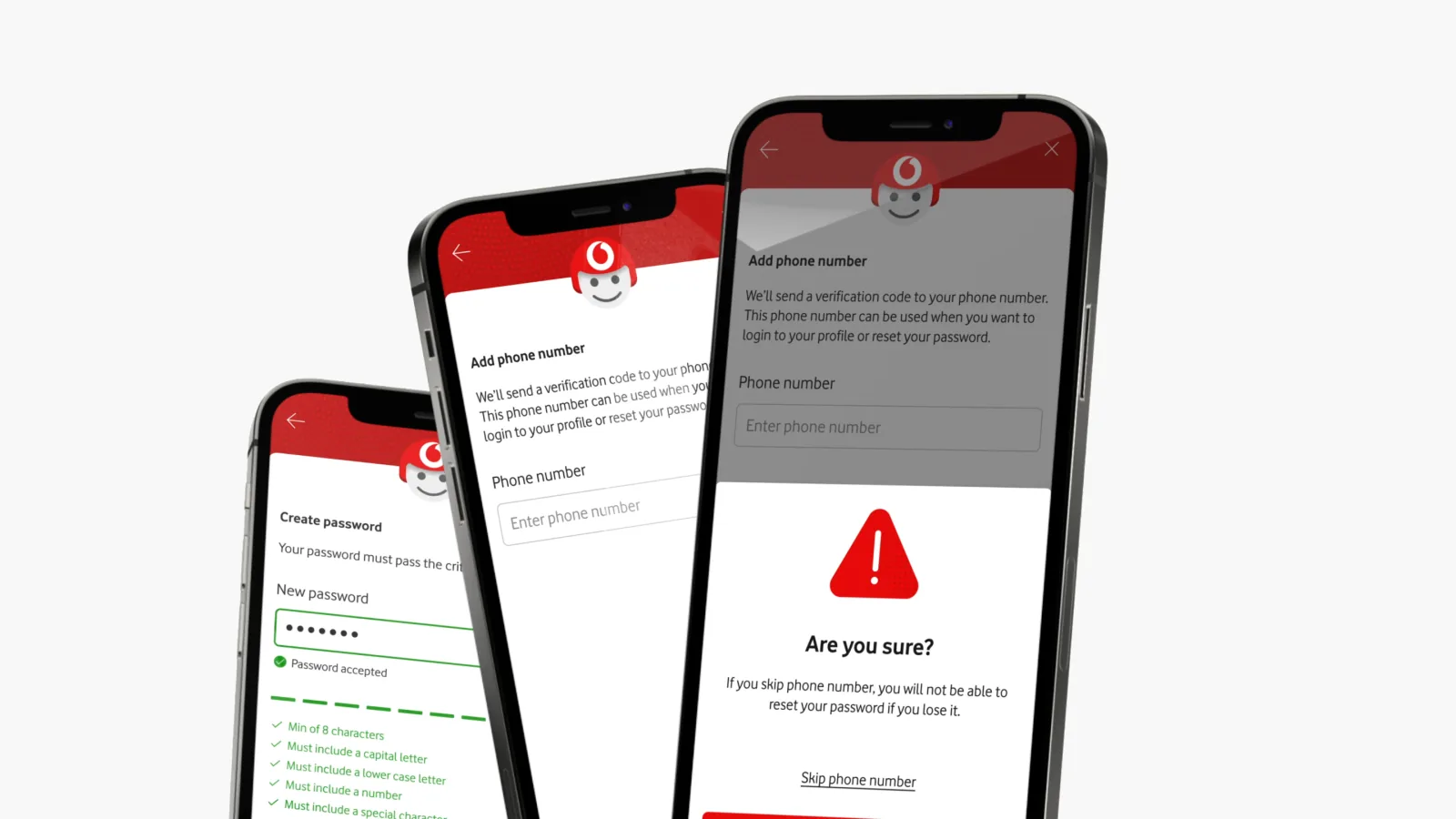
I designed a universal template for Vodafone’s identity services, from sign-up to verification, that markets around the world can adopt with minimal changes. It cut development and maintenance costs by 45%.
- Role
- Senior UX/UI Designer
- Scope
- Sign-up, sign-in and verification
- Markets
- Global, including Africa
- Result
- 45% lower development and maintenance cost
The challenge
Vodafone needed one identity template: standard enough to cut cost and complexity, flexible enough for very different markets.
Unifying identity across markets was also a chance to build trust, through verification that works the same way everywhere.
Research
I started with the people who run identity, and the people who use it.
Stakeholder interviews
Executives, product managers and technical leads, to understand business goals and user needs.
Market analysis
Cultural nuances and technical constraints across markets.
Competitive review
Identity solutions from competitors, to find gaps and openings.
Usability testing
Sessions on the existing Vodafone identity flows, to see where people struggled.
What we learned
- People want verification that is simple and secure.
- Localisation and cultural sensitivity drive trust and adoption.
- The template has to scale across very different levels of infrastructure.
Flows and design
User flows set the essential steps of every journey: verify an identifier by code, create a password or PIN, add optional two-factor, then sign in.
High-fidelity screens were built on Source, Vodafone’s design system, which kept every market on brand and every component consistent.
Testing
The redesigned flows ran in a soft launch across several markets and tested well against the existing experience.
Finding account creation, setting up two-factor and the two-factor nudge caused the most friction, so those steps were refined until every persona could get through them.
In motion
Three prototype recordings show the journeys end to end. They play silently; use the button on each to pause.
Outcome
The template became a strategic tool for growth. New markets could launch with minimal customisation, and the shared foundation opened room for cross-selling and upselling.
What I took away
- Cultural sensitivity is a feature in global products.
- Test early, test often, and fold the feedback back in.
- UX work gets traction when it is tied to business goals.
45%
lower development and maintenance cost